
The Lamu Oil Refinery, formally the Dangote East Africa Petroleum Refinery, is a project within the Industry theme. It is a privately led oil refinery and petrochemical complex proposed by Aliko Dangote’s Dangote Industries for Lamu County, beside the Port of Lamu and inside the LAPSSET corridor’s special economic zone. Ground was broken on 30 September 2026. Cost figures in the sources differ widely, from about US$15 billion to US$20 billion (roughly KES 1.9 trillion to 2.6 trillion); the figure most often quoted is KES 2.2 trillion, which this page uses in the infobox.
What it is
The refinery is designed to process 700,000 barrels of crude oil a day, which would make it slightly larger than Dangote’s 650,000 barrel a day refinery at Lekki in Nigeria.12 When Dangote first raised the idea in April and May 2026 he spoke of a 650,000 barrel copy of the Lagos plant; the 700,000 barrel figure has been used consistently since Lamu was chosen in July.34 The project company is reported as Dangote East Africa Petroleum Refinery and Petrochemicals SEZ, a subsidiary of the Dangote Group, and the site as Mokowe on the Lamu mainland.5 Other reports place it at Hindi and Manda Magogoni, also on the mainland, and earlier coverage spoke of a site on Lamu Island, so the exact footprint is not yet settled in public sources.67 Lands Cabinet Secretary Alice Wahome said the refinery would sit on about 7,000 acres of government land, with a further state parcel of more than 2,000 acres, while President William Ruto spoke of about 10,000 acres secured and another 3,000 acres sought for a special economic zone.8
The plant is planned to produce petrol, diesel and jet fuel, together with about one million tonnes a year of polypropylene. The government describes it as an integrated industrial complex with a 1,000 megawatt power plant, half of whose output would go to Kenya’s national grid, and plastics, fertiliser and chemical units. Reports disagree on how that power plant would be fuelled, some describing petroleum coke from the refinery and others liquefied natural gas from Tanzania.910 President Ruto named Kenya, Ethiopia, South Sudan, Uganda, Tanzania, Rwanda, Burundi and the Democratic Republic of Congo as the intended markets.
The refinery ties into the wider LAPSSET programme. The government’s MyGov review notes that LAPSSET’s flagship components include a crude oil pipeline from South Sudan through the Lokichar oil fields to Lamu and a refined products pipeline from Lamu to Ethiopia, and that Phase Two of Lamu Port will add a liquid bulk terminal. The original LAPSSET plan placed a 120,000 barrel a day refinery at Isiolo rather than at the coast.11
Where the crude will come from is still open. Dangote and Treasury Cabinet Secretary John Mbadi have said the refinery will take crude from Turkana’s South Lokichar field, the Middle East and United States WTI, with Dangote arguing that a refinery is not built for a single source of crude.12 At the groundbreaking Dangote pointed to Singapore as a refining centre that produces no oil of its own. President Ruto has said the government is in talks with Dangote about a crude pipeline from Turkana to Lamu.
Government rationale
President Ruto calls the refinery a government-enabled, private sector-driven project and an investment in energy security, industrialisation and regional integration.13 He has promised about 60,000 jobs, and at the groundbreaking he projected that the refinery could raise Kenya’s gross domestic product by between 12 and 15 per cent.14 He told the ceremony that Kenya spent KES 530 billion on imported petroleum products in the previous year, while cautioning that a refinery would not make that bill disappear overnight and that fuel must still be produced and delivered at a competitive price. Petroleum products are Kenya’s largest import, worth about US$4 billion a year according to official data cited by Reuters.
In the Senate on 5 August 2026, senators debating a report on fuel supply welcomed the refinery as a source of fuel reserves and supply security, pointing to disruption from the closure of the Strait of Hormuz.15
Status and timeline
Kenya has had no working refinery since the Kenya Petroleum Refineries plant in Mombasa stopped processing crude in 2013. Dangote first raised an East African refinery on 23 April 2026 at the Africa We Build Summit in Nairobi, where he offered to build a copy of his Nigerian plant if governments supported it. At that stage the site under discussion was Tanga in Tanzania, with a pipeline to Mombasa.16 President Samia Suluhu Hassan of Tanzania said publicly in early May that she had not been consulted on a joint refinery at Tanga.17 On 11 May President Ruto said Kenya would co-invest through the National Infrastructure Fund and that Dangote would choose between Tanga, Mombasa and Lamu after feasibility studies.18
By early July Dangote had settled on Lamu. On 8 July President Ruto named Deputy President Kithure Kindiki to chair the government committee for the project.19 In August Dangote offered East African governments up to 30 per cent of the equity, and Treasury later said Kenya’s allocation was 10 per cent, payable over four years, with room to take more if others declined. Ruto met Dangote and the Africa Finance Corporation’s chief executive in New York in September to discuss financing.20 A first shipment of 2,930 tonnes of equipment docked at Lamu on 26 September.21
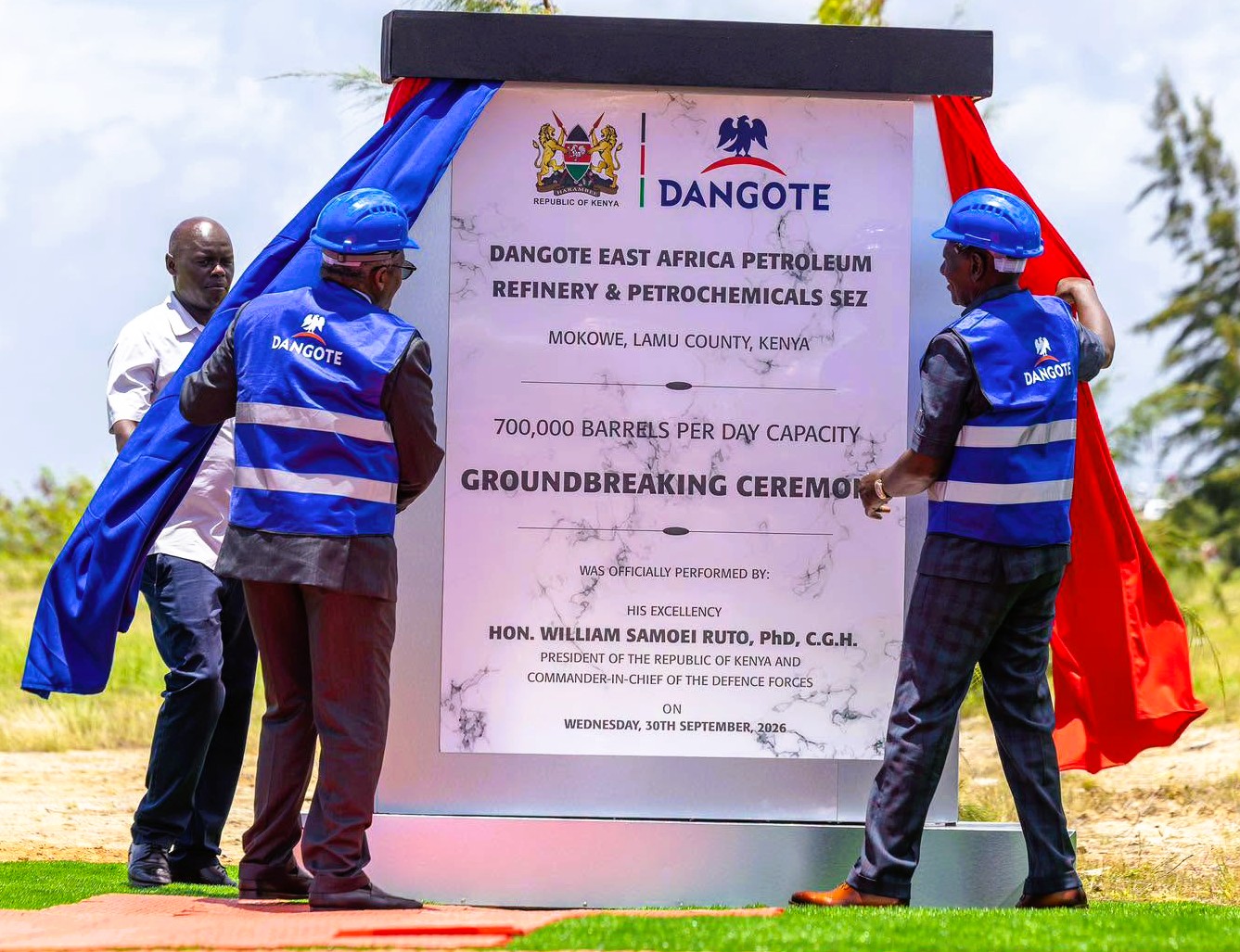
Ground was broken on 30 September 2026 in the presence of President Ruto, Dangote, President Yoweri Museveni of Uganda and Prime Minister Abiy Ahmed of Ethiopia, among other leaders.22 Construction is projected to take 30 to 40 months, with operations targeted for 2030. In October Dangote appointed Engineers India Limited as project management and engineering consultant, in a contract reported at more than US$450 million, and awarded Honeywell a process technology contract of about US$300 million.
On 14 October 2026 the Environment and Land Court at Malindi declined to extend an order that had frozen construction on part of the disputed land, finding that the residents who brought the case had not served the respondents and had cited the wrong parcel. They were given seven days to amend their case, with a further mention on 24 November 2026.23
How the project is being procured
Unlike the Lamu Spaceport, whose transaction advisory Terms of Reference were tendered by the National Treasury’s PPP Directorate in December 2025, the refinery has not been run as a solicited public private partnership. No Terms of Reference, request for proposals or transaction advisory tender for it has been published by the PPP Directorate, and it does not appear in the Directorate’s June 2026 project status report.24 It is instead a Dangote-led private investment in which the state takes an equity stake through the National Infrastructure Fund.25 A seed allocation of KES 21.5 billion through the National Infrastructure Fund was reported in July 2026.26 As of October 2026 no feasibility study, environmental and social impact assessment, NEMA licence or shareholder agreement had been made public, which is the basis of several of the challenges described below.
Who is involved
Aliko Dangote and Dangote Industries lead the project, which Dangote plans to finance with about 30 per cent equity and 70 per cent debt, drawing on internal cash, corporate bonds and a stock market listing.27 On the Kenyan side, Deputy President Kithure Kindiki chairs the implementation committee, Treasury Cabinet Secretary John Mbadi handles the state’s stake, Lands Cabinet Secretary Alice Wahome the land, and the Kenya Ports Authority the port. The Africa Finance Corporation is reported as a backer, though no loan has been disclosed. Engineers India Limited and Honeywell are the first named contractors.
Regional governments have been offered shares. Ethiopia and Rwanda have shown interest. Uganda’s President Museveni attended the groundbreaking and supports the project, but said Uganda would not invest for now and remains committed to its own 60,000 barrel a day refinery at Hoima.28
- Dangote Group
- LAPSSET Corridor Development Authority
- Kenya Ports Authority
- PPP Directorate, The National Treasury
Concerns and counterpoints
The project has drawn criticism on environmental, economic and governance grounds. The positions are set out here by who holds them.
Environment and the Lamu archipelago
Greenpeace Africa argues that the refinery threatens the mangroves, coral reefs and seagrass that support Lamu’s fisheries and protect the coast, through habitat loss, spills and air pollution. It says construction jobs would be temporary and would come at the cost of fishing and tourism, warns that the plant could become a stranded asset that locks Kenya into fossil fuels, and calls for all approvals to be frozen until an independent environmental and social impact assessment is published with public participation.29 Mohamed Adow of Power Shift Africa called the decision environmentally reckless and economically short-sighted, on the grounds that it assumes decades of fuel demand that the world is trying to phase out.30
Local voices raise similar points. The chair of the Lamu Beach Management Unit says fishers learned of the project only from the media and fear smaller catches and displacement, and Omar Elmawi of the Africa Movement of Movements Building Space warns of harm to fish breeding grounds and mangrove honey production, citing the Lamu coal plant as a precedent.31 That precedent matters in Lamu: the licence for Amu Power’s 1,050 megawatt coal plant was cancelled by the National Environment Tribunal in 2019 for an inadequate impact assessment and public participation, and the Malindi Environment and Land Court upheld the cancellation in 2025.32 Residents interviewed by AFP, including Khelef Khalifa of Muslims for Human Rights, said consultation should have come before commitments and excavation, and a tourism operator said visitors come for Lamu’s culture, not oil tankers. Dangote, for his part, described critics as people who do not want Africa to develop.33 Lamu Old Town is a UNESCO World Heritage Site, a point the government’s own review notes.
Crude supply and refinery economics
Analysts quoted by Reuters point out that Kenya has no commercial crude output yet, that Uganda’s crude is committed to the East African Crude Oil Pipeline to Tanga, and that South Sudan exports through Sudan. They note that Lamu has no working oil storage, that LAPSSET’s planned storage and tanker berths are largely unbuilt, and that a pipeline from Lokichar or South Sudan to Lamu is a distant prospect, leaving the plant reliant on the seaborne crude market. Petroleum economist Kaase Gbakon doubts the financing, since the Dangote Group is already seeking about US$40 billion for energy projects between 2025 and 2030. Against this, presidential economic adviser David Ndii estimates that the region could supply more than 600,000 barrels a day.34
Professor Fred Ogola argues that the business case has not been made: in his reckoning domestic output would meet only a small share of the refinery’s needs, regional demand of about 416,000 barrels a day falls short of its 700,000 barrel capacity while Uganda and Tanzania pursue their own refineries, and no comparison of sites, financing terms or guarantees has been disclosed.35 President Museveni recounted at the groundbreaking being told that refineries do not make a profit.36 Commentators also point to the Lagos refinery’s repeated disputes with Nigeria’s state oil company and regulators over crude allocation and import licences.37
Transparency, public money and land
The Consumers Federation of Kenya (COFEK) has petitioned the PPP Petition Committee to review Kenya’s participation, saying it has seen no subscription agreement, valuation, procurement route, feasibility study or record of public participation, and asking how the state’s stake of about KES 65 billion and the KES 21.5 billion seed allocation are being spent.38 Activist Francis Awino has a separate petition before the High Court, certified urgent, seeking disclosure of the public money, land, tax incentives and guarantees committed and the legal basis for the National Infrastructure Fund’s involvement.39 Kiharu MP Ndindi Nyoro has demanded publication of the agreement and the shareholder register, and asked whether any offtake commitment could stop Kenya importing cheaper fuel.40 Treasury Cabinet Secretary Mbadi has said that President Ruto holds no shares in the project.41
On land, 133 residents of Hindi, Manda and Magogoni say the site includes their ancestral land and that they face displacement without a resettlement plan. Their case against the government agencies, LAPSSET, Lamu County and Dangote is pending before the Environment and Land Court at Malindi. President Ruto has told Lamu residents their land concerns will be handled lawfully.42
Sources
- MyGov weekly review, Issue 14/2026-2027: Dangote Lamu oil refinery by the numbers, Government Advertising Agency (Government of Kenya), 6 October 2026.
- MyGov weekly review, Issue 5/2026-2027: Mega projects turn Coast into investment hub, Government Advertising Agency (Government of Kenya), 4 August 2026.
- Senate Hansard, Official Report, 5 August 2026, Parliament of Kenya.
- Kenya PPP Projects Progress Status Report, 30th June 2026, PPP Directorate, The National Treasury. The refinery is not listed.
- Lamu Oil Refinery, Wikipedia.
- Dangote taps EIL for Kenya grassroots refinery project, Oil & Gas Journal, 9 October 2026.
- Dangote’s proposed Kenyan oil refinery faces hurdles, not least with crude supply, Hydrocarbon Processing (Reuters), 9 September 2026.
- Greenpeace Africa statement on the proposed Dangote oil refinery in Lamu, Greenpeace Africa, 14 July 2026.
Footnotes
-
MyGov, Issue 14/2026-2027, Government Advertising Agency, 6 October 2026, pages 1 and 2. ↩
-
MyGov, Issue 5/2026-2027, Government Advertising Agency, 4 August 2026, page 2. ↩
-
Samia, Dangote hold talks in Dar es Salaam amid refinery debate, The Citizen (Tanzania), 16 May 2026. ↩
-
Kenyan president says East Africa’s biggest refinery to move ahead in Lamu, Andrew Wasike, Anadolu Agency, 10 July 2026. ↩
-
Dangote taps EIL for Kenya grassroots refinery project, Robert Brelsford, Oil & Gas Journal, 9 October 2026. ↩
-
Court temporarily halts Dangote refinery construction in Lamu on occupied portions of suit land, Zipporah Ngwatu, People Daily, 29 September 2026. ↩
-
Dangote picks Lamu for Sh2.2tn oil refinery project, Kevin Rotich, Capital FM, 8 July 2026. ↩
-
CS Wahome: Dangote Lamu refinery to be built on govt-owned land, Capital FM, 5 October 2026. ↩
-
Inside the Ksh.2 trillion Dangote Oil refinery in Lamu, Moses Kinyanjui, Citizen Digital, 29 September 2026. ↩
-
Dangote, Kenya in Talks to Build Lamu-Turkana Crude Oil Pipeline, Frankline Oduor, Kenyans.co.ke, 15 September 2026. ↩
-
Dangote’s proposed Kenyan oil refinery faces hurdles, not least with crude supply, Hydrocarbon Processing (Reuters), 9 September 2026. ↩
-
Mbadi: Kenya willing to grow stake in the Dangote refinery, Kabui Mwangi, Business Daily, 29 September 2026. ↩
-
Full Speech: Ruto’s Lamu Address at the Dangote Refinery Groundbreaking, Ken Aseka, The Kenya Times, 30 September 2026. ↩
-
Lamu’s oil refinery to create 60,000 jobs, President Ruto promises, Phidel Kizito, Capital FM, 10 July 2026. ↩
-
Senate Hansard, 5 August 2026, Parliament of Kenya, pages 22, 25 and 28 of the printed report. ↩
-
Dangote Plans Nigeria-Style Oil Refinery in East Africa, Raising Hopes for Cheaper Fuel, Maxwell Amunga, Kenyans.co.ke, 23 April 2026. ↩
-
‘Why Announce What I Don’t Know?’ Suluhu and Ruto Talk Opposites On Joint Refinery Plan, Samuel Muhimba, Nile Post via AllAfrica, 5 May 2026. ↩
-
Kenya to Invest Public Funds in Dangote-Linked Ksh 2.58 Trillion East Africa Oil Refinery, Joseph Ogungo, Kenyans.co.ke, 12 May 2026. ↩
-
Ruto appoints Kindiki to lead Sh2.2 trillion Dangote refinery project in Lamu, Christabel Adhiambo, The Star, 8 July 2026. ↩
-
Ruto Meets Dangote in New York Over Financing, Final Preparations for Sh2.2tn Lamu Refinery, Capital FM, 21 September 2026. ↩
-
Dangote Refinery: 2,930 Tonnes of Machinery Arrive in Lamu, Frankline Oduor, Kenyans.co.ke, 26 September 2026. ↩
-
President Ruto, Dangote break ground on Sh2.2tn Lamu Oil Refinery, Capital FM, 30 September 2026. ↩
-
Malindi Court Lifts Order Blocking Construction of Ksh 2.2T Dangote Lamu Oil Refinery, Samuel Mwanawanjuguna, Kenyans.co.ke, 14 October 2026. ↩
-
Kenya PPP Projects Progress Status Report, 30th June 2026, PPP Directorate, The National Treasury, published August 2026. ↩
-
Kenya: Govt to Deploy Assets, Infrastructure Fund for Sh2.2tn Lamu Refinery Investment - Ruto, Capital FM via AllAfrica, 30 September 2026. ↩
-
Dangote’s proposed Kenya refinery tests a new blueprint for African industrialisation, Andrino Akuda and Bonface Orucho (Bird Story Agency), The Independent (Uganda), 24 July 2026. ↩
-
Dangote-Backed Lamu Oil Refinery Set to Begin Construction in October 2026, Timothy Cerullo, Kenyans.co.ke, 8 August 2026. ↩
-
Uganda Yet to Commit to Dangote’s Lamu Refinery - Museveni, The Independent (Kampala) via AllAfrica, 1 October 2026. ↩
-
Greenpeace Africa statement on the proposed Dangote oil refinery in Lamu, Greenpeace Africa, 14 July 2026. ↩
-
Campaigners oppose Dangote’s planned Kenya refinery over climate and ecological risks, Vivian Chime, Climate Home News, 15 July 2026. ↩
-
Environmental activists in Kenya concerned over billionaire’s planned oil refinery, Amina Chombo, Mongabay, 5 August 2026. ↩
-
Kenya court upholds cancellation of 1,050 MW coal plant license, Mongabay, November 2025. ↩
-
Residents of Kenya’s Lamu island fear damage from mega-refinery, Africanews (AFP), 2 October 2026. ↩
-
Experts Raise Concerns Over Crude Supply, Financing for Dangote’s Lamu Refinery, Frankline Oduor, Kenyans.co.ke, 9 September 2026. ↩
-
Dangote’s Lamu Refinery: Beyond Political Praise, Where Is The Business Case?, Prof. Fred Ogola, The Kenya Times, 14 October 2026. ↩
-
Museveni backs Lamu refinery but holds off investment pending Tanga clarification, Capital FM, 30 September 2026. ↩
-
In fuel import licence dispute, NNPC accuses Dangote refinery of seeking monopoly, ThisDay, 23 May 2026. ↩
-
COFEK Seeks Review of Sh2.2tn Dangote Lamu Refinery Project, Phidel Kizito, Capital FM, 2 October 2026. ↩
-
Africa’s richest man Aliko Dangote’s Kenya refinery deal faces urgent court case, Otobong Tommy, Billionaires.Africa, 6 October 2026. ↩
-
Ndindi Nyoro demands full disclosure of Dangote Lamu refinery shareholders, Citizen Digital, October 2026. ↩
-
CS Mbadi: Ruto has no shares in Ksh.2 trillion Dangote Lamu refinery, Seth Olale, Citizen Digital, 29 September 2026. ↩
-
Dangote East Africa refinery: Ruto assures Lamu residents land concerns will be handled lawfully, Emmanuel Too, Citizen Digital, 30 September 2026. ↩
Related pages
Holding
Lamu Oil Refinery groundbreaking
President William Ruto and Aliko Dangote unveil the plaque at the groundbreaking of the Dangote East Africa Petroleum Refinery & Petrochemicals SEZ, Mokowe, Lamu County, on 30 September 2026.
Holding
MyGov 4 August 2026 Lamu oil refinery
MyGov weekly review, Issue 5/2026-2027, published by the Government Advertising Agency (Government of Kenya), 4 August 2026.
Holding
MyGov 6 October 2026 Dangote Lamu oil refinery by the numbers
MyGov weekly review, Issue 14/2026-2027, published by the Government Advertising Agency (Government of Kenya), 6 October 2026.
Holding
Senate Hansard 5 August 2026
The Senate of Kenya, Official Report (Hansard), Thirteenth Parliament, Fifth Session, sitting of Wednesday 5 August 2026.
Reference
Dangote, Kenya in Talks to Build Lamu-Turkana Crude Oil Pipeline, Frankline Oduor, Kenyans.co.ke, 15 September 2026.
Dangote, Kenya in Talks to Build Lamu-Turkana Crude Oil Pipeline, Frankline Oduor, Kenyans.co.ke, 15 September 2026.
Reference
Court temporarily halts Dangote refinery construction in Lamu on occupied portions of suit land, Zipporah Ngwatu, People
Court temporarily halts Dangote refinery construction in Lamu on occupied portions of suit land, Zipporah Ngwatu, People Daily, 29 September 2026.
Reference
Lamu's oil refinery to create 60,000 jobs, President Ruto promises, Phidel Kizito, Capital FM, 10 July 2026.
Lamu's oil refinery to create 60,000 jobs, President Ruto promises, Phidel Kizito, Capital FM, 10 July 2026.
Reference
Campaigners oppose Dangote's planned Kenya refinery over climate and ecological risks, Vivian Chime, Climate Home News,
Campaigners oppose Dangote's planned Kenya refinery over climate and ecological risks, Vivian Chime, Climate Home News, 15 July 2026.
Reference
Kenya: Govt to Deploy Assets, Infrastructure Fund for Sh2.2tn Lamu Refinery Investment - Ruto, Capital FM via AllAfrica,
Kenya: Govt to Deploy Assets, Infrastructure Fund for Sh2.2tn Lamu Refinery Investment - Ruto, Capital FM via AllAfrica, 30 September 2026.
Reference
Africa's richest man Aliko Dangote's Kenya refinery deal faces urgent court case, Otobong Tommy, Billionaires.Africa, 6
Africa's richest man Aliko Dangote's Kenya refinery deal faces urgent court case, Otobong Tommy, Billionaires.Africa, 6 October 2026.
Reference
Kenya to Invest Public Funds in Dangote-Linked Ksh 2.58 Trillion East Africa Oil Refinery, Joseph Ogungo, Kenyans.co.ke,
Kenya to Invest Public Funds in Dangote-Linked Ksh 2.58 Trillion East Africa Oil Refinery, Joseph Ogungo, Kenyans.co.ke, 12 May 2026.
Reference
Kenya PPP Projects Progress Status Report, 30th June 2026, PPP Directorate, The National Treasury, published August 2026
Kenya PPP Projects Progress Status Report, 30th June 2026, PPP Directorate, The National Treasury, published August 2026.
Reference
Full Speech: Ruto's Lamu Address at the Dangote Refinery Groundbreaking, Ken Aseka, The Kenya Times, 30 September 2026.
Full Speech: Ruto's Lamu Address at the Dangote Refinery Groundbreaking, Ken Aseka, The Kenya Times, 30 September 2026.
Reference
Dangote's Lamu Refinery: Beyond Political Praise, Where Is The Business Case?, Prof. Fred Ogola, The Kenya Times, 14 Oct
Dangote's Lamu Refinery: Beyond Political Praise, Where Is The Business Case?, Prof. Fred Ogola, The Kenya Times, 14 October 2026.
Reference
Greenpeace Africa statement on the proposed Dangote oil refinery in Lamu, Greenpeace Africa, 14 July 2026.
Greenpeace Africa statement on the proposed Dangote oil refinery in Lamu, Greenpeace Africa, 14 July 2026.
Reference
Malindi Court Lifts Order Blocking Construction of Ksh 2.2T Dangote Lamu Oil Refinery, Samuel Mwanawanjuguna, Kenyans.co
Malindi Court Lifts Order Blocking Construction of Ksh 2.2T Dangote Lamu Oil Refinery, Samuel Mwanawanjuguna, Kenyans.co.ke, 14 October 2026.
Reference
COFEK Seeks Review of Sh2.2tn Dangote Lamu Refinery Project, Phidel Kizito, Capital FM, 2 October 2026.
COFEK Seeks Review of Sh2.2tn Dangote Lamu Refinery Project, Phidel Kizito, Capital FM, 2 October 2026.
Reference
Dangote taps EIL for Kenya grassroots refinery project, Robert Brelsford, Oil & Gas Journal, 9 October 2026.
Dangote taps EIL for Kenya grassroots refinery project, Robert Brelsford, Oil & Gas Journal, 9 October 2026.
Reference
MyGov, Issue 14/2026-2027, Government Advertising Agency, 6 October 2026, pages 1 and 2.
MyGov, Issue 14/2026-2027, Government Advertising Agency, 6 October 2026, pages 1 and 2.
Reference
Dangote-Backed Lamu Oil Refinery Set to Begin Construction in October 2026, Timothy Cerullo, Kenyans.co.ke, 8 August 202
Dangote-Backed Lamu Oil Refinery Set to Begin Construction in October 2026, Timothy Cerullo, Kenyans.co.ke, 8 August 2026.
Reference
Environmental activists in Kenya concerned over billionaire's planned oil refinery, Amina Chombo, Mongabay, 5 August 202
Environmental activists in Kenya concerned over billionaire's planned oil refinery, Amina Chombo, Mongabay, 5 August 2026.
Reference
MyGov, Issue 5/2026-2027, Government Advertising Agency, 4 August 2026, page 2.
MyGov, Issue 5/2026-2027, Government Advertising Agency, 4 August 2026, page 2.
Reference
Kenyan president says East Africa's biggest refinery to move ahead in Lamu, Andrew Wasike, Anadolu Agency, 10 July 2026.
Kenyan president says East Africa's biggest refinery to move ahead in Lamu, Andrew Wasike, Anadolu Agency, 10 July 2026.
Reference
Uganda Yet to Commit to Dangote's Lamu Refinery - Museveni, The Independent (Kampala) via AllAfrica, 1 October 2026.
Uganda Yet to Commit to Dangote's Lamu Refinery - Museveni, The Independent (Kampala) via AllAfrica, 1 October 2026.
Reference
CS Wahome: Dangote Lamu refinery to be built on govt-owned land, Capital FM, 5 October 2026.
CS Wahome: Dangote Lamu refinery to be built on govt-owned land, Capital FM, 5 October 2026.
Reference
Senate Hansard, 5 August 2026, Parliament of Kenya, pages 22, 25 and 28 of the printed report.
Senate Hansard, 5 August 2026, Parliament of Kenya, pages 22, 25 and 28 of the printed report.
Reference
Ndindi Nyoro demands full disclosure of Dangote Lamu refinery shareholders, Citizen Digital, October 2026.
Ndindi Nyoro demands full disclosure of Dangote Lamu refinery shareholders, Citizen Digital, October 2026.
Reference
In fuel import licence dispute, NNPC accuses Dangote refinery of seeking monopoly, ThisDay, 23 May 2026.
In fuel import licence dispute, NNPC accuses Dangote refinery of seeking monopoly, ThisDay, 23 May 2026.
Reference
Dangote Plans Nigeria-Style Oil Refinery in East Africa, Raising Hopes for Cheaper Fuel, Maxwell Amunga, Kenyans.co.ke,
Dangote Plans Nigeria-Style Oil Refinery in East Africa, Raising Hopes for Cheaper Fuel, Maxwell Amunga, Kenyans.co.ke, 23 April 2026.
Reference
'Why Announce What I Don't Know?' Suluhu and Ruto Talk Opposites On Joint Refinery Plan, Samuel Muhimba, Nile Post via A
'Why Announce What I Don't Know?' Suluhu and Ruto Talk Opposites On Joint Refinery Plan, Samuel Muhimba, Nile Post via AllAfrica, 5 May 2026.
Reference
Residents of Kenya's Lamu island fear damage from mega-refinery, Africanews (AFP), 2 October 2026.
Residents of Kenya's Lamu island fear damage from mega-refinery, Africanews (AFP), 2 October 2026.
Reference
Mbadi: Kenya willing to grow stake in the Dangote refinery, Kabui Mwangi, Business Daily, 29 September 2026.
Mbadi: Kenya willing to grow stake in the Dangote refinery, Kabui Mwangi, Business Daily, 29 September 2026.
Reference
Kenya court upholds cancellation of 1,050 MW coal plant license, Mongabay, November 2025.
Kenya court upholds cancellation of 1,050 MW coal plant license, Mongabay, November 2025.
Reference
Dangote picks Lamu for Sh2.2tn oil refinery project, Kevin Rotich, Capital FM, 8 July 2026.
Dangote picks Lamu for Sh2.2tn oil refinery project, Kevin Rotich, Capital FM, 8 July 2026.
Reference
CS Mbadi: Ruto has no shares in Ksh.2 trillion Dangote Lamu refinery, Seth Olale, Citizen Digital, 29 September 2026.
CS Mbadi: Ruto has no shares in Ksh.2 trillion Dangote Lamu refinery, Seth Olale, Citizen Digital, 29 September 2026.
Reference
Inside the Ksh.2 trillion Dangote Oil refinery in Lamu, Moses Kinyanjui, Citizen Digital, 29 September 2026.
Inside the Ksh.2 trillion Dangote Oil refinery in Lamu, Moses Kinyanjui, Citizen Digital, 29 September 2026.
Reference
Dangote Refinery: 2,930 Tonnes of Machinery Arrive in Lamu, Frankline Oduor, Kenyans.co.ke, 26 September 2026.
Dangote Refinery: 2,930 Tonnes of Machinery Arrive in Lamu, Frankline Oduor, Kenyans.co.ke, 26 September 2026.
Reference
Dangote East Africa refinery: Ruto assures Lamu residents land concerns will be handled lawfully, Emmanuel Too, Citizen
Dangote East Africa refinery: Ruto assures Lamu residents land concerns will be handled lawfully, Emmanuel Too, Citizen Digital, 30 September 2026.
Reference
Samia, Dangote hold talks in Dar es Salaam amid refinery debate, The Citizen (Tanzania), 16 May 2026.
Samia, Dangote hold talks in Dar es Salaam amid refinery debate, The Citizen (Tanzania), 16 May 2026.
Reference
Ruto appoints Kindiki to lead Sh2.2 trillion Dangote refinery project in Lamu, Christabel Adhiambo, The Star, 8 July 202
Ruto appoints Kindiki to lead Sh2.2 trillion Dangote refinery project in Lamu, Christabel Adhiambo, The Star, 8 July 2026.
Reference
President Ruto, Dangote break ground on Sh2.2tn Lamu Oil Refinery, Capital FM, 30 September 2026.
President Ruto, Dangote break ground on Sh2.2tn Lamu Oil Refinery, Capital FM, 30 September 2026.
Reference
Dangote's proposed Kenyan oil refinery faces hurdles, not least with crude supply, Hydrocarbon Processing (Reuters), 9 S
Dangote's proposed Kenyan oil refinery faces hurdles, not least with crude supply, Hydrocarbon Processing (Reuters), 9 September 2026.
Reference
Ruto Meets Dangote in New York Over Financing, Final Preparations for Sh2.2tn Lamu Refinery, Capital FM, 21 September 20
Ruto Meets Dangote in New York Over Financing, Final Preparations for Sh2.2tn Lamu Refinery, Capital FM, 21 September 2026.
Reference
Experts Raise Concerns Over Crude Supply, Financing for Dangote's Lamu Refinery, Frankline Oduor, Kenyans.co.ke, 9 Septe
Experts Raise Concerns Over Crude Supply, Financing for Dangote's Lamu Refinery, Frankline Oduor, Kenyans.co.ke, 9 September 2026.
Reference
Dangote's proposed Kenya refinery tests a new blueprint for African industrialisation, Andrino Akuda and Bonface Orucho
Dangote's proposed Kenya refinery tests a new blueprint for African industrialisation, Andrino Akuda and Bonface Orucho (Bird Story Agency), The Independent (Uganda), 24 July 2026.
Reference
Museveni backs Lamu refinery but holds off investment pending Tanga clarification, Capital FM, 30 September 2026.
Museveni backs Lamu refinery but holds off investment pending Tanga clarification, Capital FM, 30 September 2026.